
Testament (March 2025)
The sum of my work on the Earth’s interior and how it relates to plate tectonics seems to be not widely appreciated in the relevant science community. Some of it has been recognised, notably by the inaugural Augustus Love Medal of the European Geoscience Society in 2005, and my book Dynamic Earth, which is a standard reference and graduate teaching source.
That work is mainly on the physics and dynamics of mantle convection. However it was far from clear whether chemical and isotopic observations were consistent with this picture. The later part of my work showed how the chemistry can be reconciled with the physics, thus arriving at a single unified account of how the mantle works.
This account essentially presents the fundamental theory of geology – the source of all the processes at work below the solid surface that result in mountain building, ore deposition and all the rest.
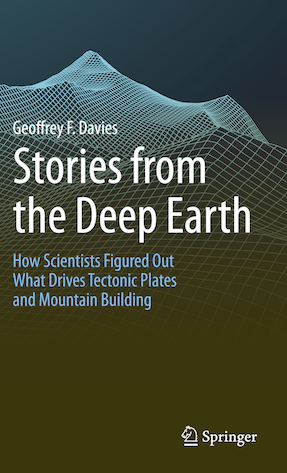
However my later work on reconciling the geochemistry has hardly been noticed, and the resulting integrated account has, as a consequence, been similarly neglected. I have therefore written a summary of the work, so there is some record of it archived and future students of the Earth might find it. The nine-page summary is accessible here. A much fuller account, without mathematical or other technical detail can also be found in the book Stories from the Deep Earth displayed below.
Stories from the Deep Earth
After a long career studying the physics of the deep Earth I have written a memoir/history of how the deep mantle works to drive plates and continents around and of my adventures with the subject and the other scientists.
How scientists figured out what drives tectonic plates and mountain building
Plate tectonics can drift continents and push up mountains, but what drives the plates? This is an insider’s account of how we answered questions posed over two centuries ago, and completed geology’s quest for a driving mechanism. Forging through confusing evidence, apparent contradictions and raging debates we arrived at not one but two mechanisms: sinking plates and rising plumes.
 BetterNatureBooks